From Neighborhood Expert to Trusted Advisor: How to Win the Listing Appointment in 2026

In our previous guide, "Owning Your Neighborhood," we discussed the top-of-funnel strategies required to build a hyperlocal brand. We covered how to use video marketing, community pages, and geographic farming to attract the attention of local homeowners.
However, generating a lead is only the first step. The ultimate test of your real estate business is what happens when a seller finally raises their hand and says, "I'm thinking about selling my house."
At Philadelphia Real Estate Classes, I coach agents every week who have spent thousands of dollars generating leads, only to lose the listing at the kitchen table to a competitor. In the 2026 market, sellers are more educated, more cautious, and more demanding than ever before. The traditional, two-hour "dog and pony show" listing presentation is dead .
To convert a lead into a signed listing agreement today, you must transition from being a neighborhood marketer to a trusted, professional advisor. Here is the modern framework for winning the listing appointment in 2026.
The Pre-Listing Phase: Winning Before You Arrive
The biggest mistake agents make is assuming the listing presentation begins when they knock on the front door. In reality, the appointment is often won or lost in the 48 hours prior to the meeting.
Sellers in 2026 do not want to sit through a lengthy presentation about your brokerage's history or your personal biography . They want to know how you are going to solve their specific problem. You can eliminate the majority of their objections before you even arrive by utilizing a comprehensive Pre-Listing Package.
The Power of the Pre-Listing Package
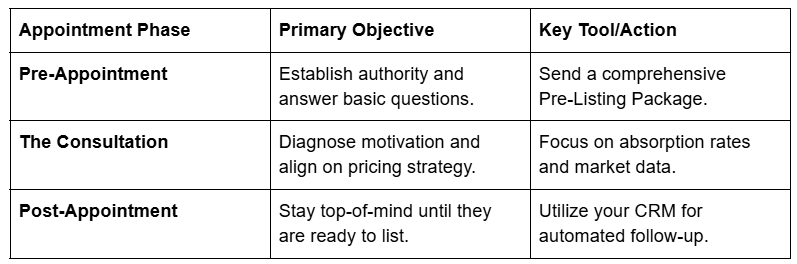
A pre-listing package is a digital or physical dossier sent to the seller immediately after booking the appointment. It serves as a "super-charged resume" that answers their foundational questions, allowing you to focus the actual meeting on strategy rather than introductions.
Your 2026 Pre-Listing Package should include:
- Your Professional Track Record: Key statistics such as your average days on market versus the MLS average, and your list-to-sale price ratio.
- Your Marketing Plan: A clear, visual outline of exactly how you will market their home, including your use of video, social media targeting, and professional staging.
- The Commission Structure: Transparency is paramount. Address how your fee is structured and the value you provide in exchange.
- Testimonials: Three to five strong reviews from sellers in their specific neighborhood or a similar demographic.
By sending this information ahead of time, you establish immediate authority and respect for the seller's time.
The Consultation Framework: Stop Presenting, Start Diagnosing
When you sit down at the kitchen table, your mindset must shift. You are not there to "pitch" your services; you are there to diagnose their situation and prescribe a solution. Treat the appointment like a professional consultation.
1. The Discovery Phase
Before you open your laptop or present a Comparative Market Analysis (CMA), you must understand their motivation. Why are they moving? What is their ideal timeline? What are their biggest fears about the process?
If you do not understand their underlying motivation, you cannot effectively price the home or negotiate on their behalf.
2. The Pricing Strategy
Pricing a home in 2026 requires more than simply pulling three recent comps. You must educate the seller on the current market dynamics.
Explain the concept of the "absorption rate"—how fast homes are currently selling in their specific neighborhood. If the absorption rate in Fishtown is currently three months, but they need to move in 30 days, that data must dictate the pricing strategy. Do not price solely based on past sales; price based on current market trajectory.
3. The "Interviewing Other Agents" Objection
Recent data indicates that while 72% of sellers only interview one agent, the sellers who do interview multiple agents are often the ones with the most desirable properties.
If a seller tells you they are interviewing two other agents, do not panic and do not discount your commission. Instead, lean into your hyperlocal expertise and your marketing systems.
The Script: "I think it is incredibly smart that you are speaking with other professionals. When you meet with them, I highly recommend asking exactly how they plan to market your home beyond just putting it on the MLS. At Philadelphia Real Estate Classes, we use a system called LocalVantage.us that allows us to digitally target buyers who are actively searching for homes in this specific zip code. Make sure whoever you hire has a proactive, not reactive, marketing strategy."
By confidently referencing your systems—like the LocalVantage.us CRM and marketing platform we use with our coaching clients—you position yourself as a modern, tech-enabled professional, rather than an agent relying on outdated tactics.
The Follow-Up: Converting the "Not Yet" Seller
Not every listing appointment ends with an immediate signature. Often, sellers are 3 to 6 months away from actually putting their home on the market.
This is where your CRM becomes your most valuable asset. If you walk out the door without a signed agreement, that seller must immediately go into a long-term nurture campaign. Set them up to receive automated neighborhood market updates, send a handwritten thank-you note for the meeting, and schedule a check-in call for 30 days later.
The Bottom Line
Winning a listing in 2026 is not about having the most charismatic personality; it is about having the most professional process. By implementing a strong pre-listing package, focusing on the seller's specific needs during the consultation, and leveraging your tech stack for follow-up, you will convert your hard-earned leads into signed listing agreements.
References